By: Joe Schimmel
Emergent Church Leader, Rob Bell, has lit up the blogosphere with the firestorm he is causing with what many believe to be heretical views on God, Christ, and Salvation in his new book, Love Wins.
The book is currently number one in Amazon’s “Religion and Spirituality” section. The subtitle of Bell’s book reads that it is “a book about heaven, hell, and the fate of every person who ever lived.”
The Emerging Church has often been described as being as hard to define as nailing Jell-O to a wall. This is, in part, because the pieces are always moving and emergent leaders are continually redefining themselves. It is also due to the fact that there is no genuine commitment to propositional truth, so emergent leader’s tend to be very evasive and their lies are as slippery as an eel. You never seem to get straight answers. This was demonstrated most vividly in Rob Bell’s recent interview with Martin Bashir on MSNBC.
During the interview, Bell squirmed and dodged query after query like a belly dancer on speed, as Martin Bashir confronted him with his unscriptural ideas about Hell and universal salvation. If nailing down the views of the Emerging Church is like nailing Jell-O to the wall, Bell’s interview with Bashir was like watching Jell-O (Rob Bell) getting splattered against the wall (Martin Bashir)!
This is what happens when a smarmy postmodernist, who has capitulated and conformed to the world, is confronted with being consistent and telling the truth.
When you listen to Bell, you have to ask, “What ever happened to the holiness of God and the sinful nature and depravity of man? How about the wrath of God? Or, the straight gate and the narrow road that Jesus speaks of?”
According to Bell, who views Hell through rose-colored glasses, Hell is just one last pit stop a person makes before Heaven. After a long life of rebellion against God…if it’s too hot…don’t worry, you can choose to accept God’s love and you will be whisked away to the streets of gold!
For Rob Bell, Hell, is merely an emergent ‘purgatory’ where men like Adolph Hitler and Joseph Stalin are being held for “pruning” and “correction.” It has nothing to do with the wrath of God. Hell is simply what we make it. If you change your mind and want to go to Heaven, all you have to do is find the exit. If Hell is too uncomfortable, you will have infinite chances to get right with God by accepting his love; which, Bell claims will ultimately melt the heart of every man. Tragically, this deception misleads people into believing that they will be able to escape Hell long after they have been dead and buried.
Bell vs. Bashir
 As Martin Bashir interviewed Rob Bell, the words “Bell Accused of Committing Heresy”were emblazoned across the television screen and Bashir stated that the “mega church pastor has ignited a theological firestorm by suggesting that… all will be saved. He argues people will be persuaded by God’s love, postmortem in the life to come.” Bashir, a professing Christian himself, accused Bell of soft peddling Hell and fleecing the flock:
“You’ve indicated one of the problems with the book, you’re creating a Christian message that’s warm, kind, and popular, for contemporary culture but it’s, frankly, according to this critic, unbiblical and historically unreliable. That’s true, isn’t it?”
Bashir, sensing Bell’s duplicity, became irritated by Bell’s refusal to give him a straight answer, and then accused him of speaking out of both sides of his mouth. After Bell tersely denied that he was a Universalist, Bashir immediately followed with a scathing indictment:
“You’re amending the gospel so that it’s palatable to contemporary people who find, for example, the idea of Hell and Heaven very difficult to stomach. So here comes Rob Bell, he’s made a Christian gospel for you and it’s perfectly palatable, it’s easy to swallow.”
At this point, Bell knew he was in deep trouble. He was being exposed before a national audience. On the one hand, he was clearly espousing a version of universal salvation, yet in the same breath he was denying that fact and lying through his teeth! In his effort to appeal to the masses with his watered down version of Hell and the Gospel, Bell became painfully aware that by blatantly admitting Universalism, he would be placing himself completely outside the pale of Christian orthodoxy and be considered a heretic.
Overall, Rob Bell knows if he comes clean he could potentially lose a large segment of his evangelical audience, which has long grown tired of his balancing act on the precipice of orthodoxy and heterodoxy. He is a Universalist, but knows if he fully leaves the closet and clearly proclaims his heretical views he will severely compromise his following.
Martin Bashir was right. Rob Bell is changing the message of the Gospel for the sake of broadening his audience. In his book, Love Wins, Bell tells us that the traditional understanding of Christ’s teaching on Heaven and Hell “isn’t a very good story” (p. 110). Bell wants a story that will make unrepentant rebels against God feel comfortable in their sin.
Tickling Itching Ears
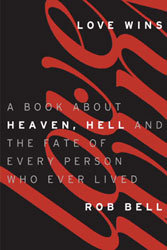 In Chapter Four of Love Wins, Bell criticizes some statements of faith that he has taken from evangelical church websites that reflect Jesus’ teachings on Hell: “The unsaved will be separated forever from God in hell.” After giving a number of examples with which he feels uncomfortable, Bells states, “All this, on a website. Welcome to our church.” (pp. 95-96). Here, we see Bell’s real concern, he wants people to feel welcomed to his church. He doesn’t want Jesus’ true teachings on Hell to diminish the numbers.
Bell states that “no amount of clever marketing will attract people if we teach that ‘God will punish people for all of eternity.’”So he forges his own brand of “marketing” by redefining Hell and diminishing its horrors. Bell empties Hell of God’s wrath and shortens its duration.
Bell claims that by softening the message, the Gospel will become more attractive to non-believers. It is true that a watered down message will increase the number of non-believers at ice cream socials and Christian love feasts; but, at what point does changing the message of the Lord Jesus Christ make the true Gospel a ‘different’ gospel? What right do we have to change the everlasting Gospel?
The truth is Jesus taught that the Father is seeking those who will worship Him in spirit and in truth (John 4:23-24). We are commanded to present the Gospel to a lost and dying world and to preach and teach God’s Word off the very pages of Holy Scripture. To do anything less is to betray the one true God who sent His only begotten Son to save us. We are not loving others, as Jesus commands us to do, if we do not present them with God’s truth and the very real consequences that await those who reject Him.
Bashir’s accusation that Bell is changing the Gospel to make it more palatable to popular culture is what the apostle Paul warned false teachers would do in the last days:
“Preach the word; be ready in season and out of season; reprove, rebuke, and exhort, with complete patience and teaching. For the time is coming when people will not endure sound[ teaching, but having itching ears they will accumulate for themselves teachers to suit their own passions, and will turn away from listening to the truth and wander off into myths.”
–2 Timothy 4:2-4
The false doctrine of Universalism has been called the “beautiful heresy” because it is seductive and tickles the ears. Before Rob Bell’s revealing interview with Martin Bashir, Bell was interviewed by Christian media which lobbed him one soft ball after another so he could always hit them right out of the PR park. What a shame, that it took a liberal news organization filled with Godless atheists, like MSNBC, to hold Rob Bell’s feet to the fire and confront him with compromising the biblical message to accommodate popular culture. Incredibly, it appeared far more as though Martin Bashir was the informed pastor, and Rob Bell the novice.
In a radio interview with Paul Edwards that was conducted after Martin Bashir exposed Bell, Edwards stated that Bashir had raised the ire of the liberal emergent crowd because their Goliath couldn’t answer the questions and was brought down.
Bashir told Edwards that after reading Rob Bell’s book propagating the heresy of Universalism, that Bell was dishonest in his handling of church history and Holy Scripture. Bashir accused Bell of making deliberate historical errors to support his views on Universalism. He stated that Bell would not admit he was a Universalist even though it is stated as much in Love Wins.
Bashir summed up Bell’s book, Love Wins this way:
“[H]e says in his book ‘God’s love melts everything in the end, and at the end of the day, you can be antagonistic toward Christianity, but after you die, God’s love will melt your opposition, and you’ll walk into heaven.”
He told Edwards that Bell is chipping away at the Gospel and reshaping it so that he will not be offensive, but in effect, he is emptying it of its critical content and at the same time, strategically positioning it as ‘mainstream evangelical.’
He further stated that if Bell were to have admitted what he was really teaching in his MSNBC interview, his constituency would have run for cover and he would lose his popularity. Bashir said, “When I read the book… I saw what I believe… is an egregious disregard for history, and a treatment of biblical text in the most selective and perfunctory manner.”
Rob Bell’s denial on MSNBC of the heresy of universal salvation is not only betrayed by the content of his book, but by his own church’s (Mars Hill) FAQs page. As you can see with your own eyes, according to the Mar’s Hill website, he is at the very least, a “hopeful Universalist.”
The Love Wins FAQ’s state that Bell holds that:
“Those who reject the invitation [to salvation] experience a purifying “fire” of judgment in hell, yet there is hope…. Love Wins helps us have a biblical imagination that leaves room for the hope of the redemption of all while recognizing humanities free will to continue to reject God….[Bell] is proposing that God’s love is so big that the invitation to God’s grace may extend into the next life so that all could be saved.”
(Click Here for a PDF of the original Love Wins FAQ. It has since been updated on their site due to the firestorm caused over the book.)
 The emergent-friendly, Global Dictionary of Theology, makes a distinction between ‘Hopeful Universalism’ and ‘Convinced Universalism’:
“Hopeful universalism finds reason in Scripture to be hopeful that everyone will be saved, but they do not believe that we can be certain of this. Convinceduniversalists, on the other hand, are certain about this, despite of the fact that Christians have traditionally believed that the Bible clearly teaches that some will be eternally condemned.”
However, Bell speaks with a forked tongue. Bell vacillates between being a ‘hopeful universalist’ and a ‘convinced universalist’, stating, “we may get other opportunities [in hell] (Hopeful Universalism)” (p. 197); but ultimately, “NO ONE can resist God’s pursuit forever because GOD’S LOVE WILL EVENTUALLY MELT EVEN THE COLDEST HEARTS.” (p. 108, emphasis added)
Read that last line again and tell me that Rob Bell is not a “Convinced Universalist!” Whether he speaks like a hopeful or a convinced Universalist, he is a Universalist, nevertheless!
Add this to the fact that Bell promotes in Love Wins, “At the heart of this perspective is the belief that, given enough time, everybody will turn to God and find themselves in the joy and peace of God’s presence. The love of God will melt every hard heart, and even the most ‘depraved sinners’ will eventually give up their resistance and turn to God.” (p. 107)
Will All, Most or Few Be Saved?
 Indeed, in the very preface of Love Wins, Bell contradicts Jesus’ teaching that few would actually be saved. Bell writes:
“There are a growing number of us who have become acutely aware that Jesus’ story has been hijacked by a number of other stories, stories Jesus isn’t interested in telling…. A staggering number of people have been taught that a select few Christians will spend forever in a peaceful, joyous place called heaven, while the rest of humanity spends forever in torment and punishment in hell with no chance for anything better.” (Rob Bell, Love Wins, from p. viii of the preface)
Where did hundreds of millions of Christians, over the last 2,000 years, ever get the notion that the way to eternal life was narrow, and that few would enter by the narrow gate to be saved? That notion, of course, came directly from the lips of our beloved Lord Jesus himself:
“Then Jesus went through the towns and villages, teaching as he made his way to Jerusalem. Someone asked him, “Lord, are only a few people going to be saved?” He said to them, “Make every effort to enter through the narrow door, because many, I tell you, will try to enter and will not be able to.” –Luke 13:22-24
“Enter through the narrow gate. For wide is the gate and broad is the road that leads to destruction, and many enter through it. But small is the gate and narrow the road that leads to life, and only a few find it.” –Matthew 7:13-14
Jesus stated as clearly as it could be stated, that only a “few” find the “narrow door”… and “narrow… Road”… that “leads to life,” while “many” take the “wide” and “easy” road that “leads to destruction.”
I hope and pray that those who have fallen prey to Satan’s wiles through the Emerging Church Movement will wake up and choose the teachings of the Lord Jesus Christ over those of Rob Bell! If we choose Rob Bell’s teachings over and above the teachings of the Lord Jesus Christ, can we truly call ourselves Christians? Obviously not!
Contrary to Bell’s heretical teaching that Jesus will accept their repentance later in Hell, Jesus said many “will try to enter and will not be able to.”
Who then is really hijacking the Christian faith?
Apparently, it is Rob Bell and other Emergent Leaders who have sought to distort the message of Jesus by telling stories that make the masses feel comfortable in their sin. After all, if they go to Hell, Bell assures them that he believes God will give them many more opportunities to come to God!
Sadly, such teaching will lead many to conclude, “Who cares how wickedly we live? Who cares about those who are starving to death around the world and who have not heard the Gospel? Who cares how many lives we destroy? Why not live like ‘hell’ if we can still go to Heaven?” As the song by Prince states, “Let’s party like it’s 1999!”
Rob Bell states that those who hold to what has traditionally been understood to be the biblical teaching of Heaven and Hell “don’t throw very good parties” (p. 179). That may be true… if you “call evil good and good evil”(Isaiah 5:20) and you believe, contrary to the scriptures, that “drunkards, adulterers and fornicators will inherit the kingdom of God.” (1 Cor. 6:9-10, Eph. 5:5-8, Gal. 5:19-21, 6:7-9, Rev. 21:8, 22:15)
Of course, if you are a Universalist like Bell, you are ignoring Christ’s warnings of the eternality of Hell and His call to holiness and the narrow road. You are misleading the masses and providing them with a false hope that they will one day get to Heaven… eventually.
For Rob Bell, the gate to eternal life is broad. Bell states in Love Wins, “What Jesus does is declare that he, and he alone, is saving everybody. And then he leaves the door way, way open.” According to Bell, so broad and wide is the narrow road, that you can take the broad road to Hell with the assurance that Jesus continues to “leave the door way, way open” until you decide to take the wide gate into Heaven. Contrasting this to the teachings of Jesus, this is an outright lie and a major deception!
False Prophets Among Us
 It is a sobering thought that Jesus went on to state in the verses immediately following His teaching on the narrow and broad roads, that false prophets would come in sheep’s clothing (Matthew 7:15-21). Such false prophets stand at the cross roads between the broad and narrow road, claiming to represent Christ, while pointing their followers toward the broad road that leads destruction, assuring them that it eventually leads to Heaven. Consider this for a minute. Isn’t this exactly what Rob Bell is doing?
The Lord warned us in His Word that we are to earnestly contend for the faith, for false prophets would come and turn the grace of God into a license to sin (Jude 1:4). Rob Bell is turning the finished work of Christ into an open sesame, a license to sin with impunity in this life while guaranteeing a shot at Heaven after spending time in Hell!
Bell teaches, “Forgiveness is unilateral. God isn’t waiting for us to get it together, to clean up, shape up, get up—God has already done it” (p. 189). He deceptively claims that you don’t need to do anything right now, you can simply live like hell and cash your check after you die and go to eternal bliss!
Bell also erroneously teaches that:
“Any time someone makes you feel guilty about how you are living, that is part of the old system (pre-Christ).”
This unbiblical claim by Rob Bell that God will eventually melt the hardest hearts in Hell and bring them to Heaven implies that Mao Zedong, Josef Stalin, Adolf Hitler, Genghis Khan, and even Judas Iscariot, will one day be able to walk the streets of gold! Never mind that Jesus said it would be better for Judas that he was never born (Matthew 26:24). As we have seen, Bell tells us that “no one” can resist God’s salvific will.
If Bell is right, and anyone and everyone receives more opportunities to come to Christ in Hell, then Jesus was wrong when he warned that the blasphemy of the Holy Spirit was an unpardonable sin. (Matthew 12:31-32, Luke 12:10, Mark 3:28-29)
What kind of deterrent would it be to tell a group of potential serial killers, rapists and child molesters that they need not worry about repenting or going to prison for the rest of their lives, or suffering the death penalty because they have already been forgiven? If this fact holds true, all they would need to do is tell the judge they will receive his love later. However, if they still end up in prison for some reason, they still can – on their own accord later – change their minds and the judge would freely let them out and even pay for an awesome vacation to the Bahamas or another island paradise! What a deal!
Logically, this kind of mindset would only encourage criminals to continue on with their wicked and perverse thoughts and deeds. However, Rob Bell is offering this same type of counterfeit hope of post mortem salvation, which is absolutely foreign to the teaching of the Lord Jesus Christ. Tragically, this deceiving and licentious doctrine will prove to be a powerful satanic attack that will actually help to swell the population of Hell. Many of those who might otherwise repent, will sadly buy into Bell’s lie and take his false doctrine to its practical conclusions. Wrong doctrine leads to wrong living and could potentially lead many straight to Hell for all eternity.
Rob Bell is promising his vast audience eternal life, even if they choose to continue in their sin and earthly rebellion against God. This is essentially the false doctrine that God rebuked the false prophets of spreading in the days of Ezekiel:
“And you have encouraged the wicked by promising them life, even though they continue in their sins.” –Ezekiel 13:22b
In contrast, God warned Ezekiel that he had better be faithful to preach His warnings or the blood of the lost would be on his head:
“Son of man, I have made you a watchman for the people of Israel; so hear the word I speak and give them warning from me. When I say to the wicked, ‘You wicked person, you will surely die,’ and you do not speak out to dissuade them from their ways, that wicked person will die for their sin, and I will hold you accountable for their blood.” –Ezekiel 33:7-8
James warned that not many of us are to be teachers, for teachers will receive a stricter judgment (James 3:1). The apostle Paul was faithful to share both the totality of Jesus’ Gospel and preached “the goodness and severity of God” (Romans 11:22). Paul understood the eternal consequences of Jesus’ message and knew that he would have to preach the whole counsel of God if he was to be free from the blood of those he shared with:
“Therefore I testify to you this day that I am innocent of the blood of all men. For I have not shunned to declare to you the whole counsel of God. Therefore take heed to yourselves and to all the flock, among which the Holy Spirit has made you overseers, to shepherd the church of God which He purchased with His own blood. For I know this, that after my departure savage wolves will come in among you, not sparing the flock.” –Acts 20:26-27
Tragically, Rob Bell and other emergent leaders, have a lot of blood on their hands.
Bell Waters Down Hell
 Rob Bell not only redefines Hell by teaching that it will only be a temporary abode for those who want to leave later, but he redefines Hell by claiming that it is not so much about the after life, but it’s about what you make of the life here and now. In his book, Velvet Elvis, Bell had already stated this position:
“For Jesus, heaven and hell were present realities. Ways of living we can enter into here and now. He talked very little of the life beyond this one…” –Rob Bell (Velvet Elvis, p. 147)
Bell seems to be thinking that most of his audience is biblically uniformed, as he claims that the Rich Man and Lazarus (Luke 16) was not really so much about the rich man going to Hades after he died, but about the “hell” he was supposedly making of his life in the here and now (pp. 77-79).
In Chapter Seven of Love Wins, Bell states:
“Hell is our refusal to trust God’s retelling of our story,” and “We create hell whenever we fail to trust God’s retelling of our story.”
Bell denies the biblical Hell by stripping Hell of all of the fire, wrath, darkness, and torment that Jesus described.
For Rob Bell, Hell is:
“…a word that refers to the big, wide, terrible evil that comes from the secrets hidden deep without our hearts all the way to the massive, society-wide collapse and chaos that comes when we fail to live in God’s world God’s way.” (p. 95)
Bell also believes:
“We do ourselves great harm when we confuse the very essence of God, which is love, with the very real consequences of rejecting that love, which creates what we call hell.” (p. 177)
Bell’s teaching that Hell is what you make it and you are already experiencing it now on earth will allow many to view Hell as quite heavenly. Since there is pleasure in sin for a season, many sinners will consequently be quite happy with the hell they have made and will see no reason to repent until the ‘kicks’ turn to ‘kick backs’ and it is too late.
Bell the Preterist
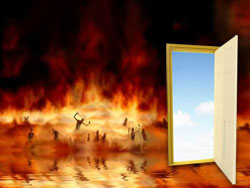 Rob Bell takes every possible liberty to deny reality and to either explain Hell away or get everyone into Heaven, regardless of his or her rejection of God and the Gospel. Bell not only empties Hell of God’s holy wrath, he creates an exit door from the inside out and claims that Hell is merely what we make it. He also claims that most of the imagery of future judgments in Hell were fulfilled on earth in AD 70 (p. 81).
Of course, Bell’s appeal to preterism falls flat for a plethora of exegetical reasons. It will suffice at this juncture to point out that the early church fathers, such as Polycarp (who was a disciple of the apostle John) and Irrenaeus, inform us that the book of Revelation was written by the apostle John during the reign of Domitian in the 90’s, more than 20 years after the destruction of Jerusalem. Thus, the book of Revelation, for that reason and many others, could not have been describing what happened in AD 70!
Ultimately, Rob Bell trivializes what Hell really is. While Bell speculates and redefines Hell in his interview with Martin Bashir, he accuses Christians – who take Jesus at face value – as speculating about what happens after death. He stated, “My experience has been a lot of Christians built whole dogmas about what happens when you die, and we have to be very careful we don’t build whole doctrines and dogmas on what is speculation.” To this, Bashir wisely responded, “You’re the one making speculation about the after life.”
Rob Bell’s unscriptural and wild speculation about Hell being a temporary abode is more akin to world religions like Islam, and cults like Mormonism, than it is Christianity!
Those of us who know God do not have to speculate about the after life. We are speculating when we believe God’s faithful testimony.
“And as it is appointed for men to die once, but after this the judgment.” –Hebrews 9:27
The Bible also clearly teaches that those who die with genuine faith in Jesus Christ will be “absent from the body… [and] present with the Lord.” (2 Cor. 5:8, Phil 1:21-23, Hebrews 12:22-23, Revelation 6:9)
Jesus declared that one must be born again to enter the kingdom of God (John 3:3, 5, 7). Jesus also made it clear that those who will not believe will be condemned (John 3:16-21). Jesus further declares that those who refuse to come to Him would die in their sins (John 8:24).
Jesus made it clear that those who reject Him go to Hades upon death (Luke 16:19-31). He further revealed in the book of Revelation that Hades is a temporary holding facility (like a county jail) and that after Christ’s millennial reign the wicked dead will be raised and appear at the great white throne judgment. At that point, they will be judged by their deeds and cast into the lake of fire along with Hades itself (Revelation 20:11-15, 21:8, 22:15). The revelation of Christ reveals that even after being in the lake of fire for over a thousand years, ‘the beast’ and ‘the false prophet’ will still be there (Revelation 20:10).
There is no hint or indication that anyone will receive a second chance in Hades or the lake of fire. Rather, Jesus revealed that there will be no rest, day and night, forever and ever (Revelation 14:9-12).
Eternal or Temporal Punishment?
 By claiming that the unrepentant wicked will have a chance to get to Heaven from Hell, Rob Bell has gone beyond that of Edward W. Fudge, who states in The Fire That Consumes, “the wicked, following whatever degree and duration of pain that God may justly inflict, will finally and truly die, perish and become extinct for ever and ever.” (Fudge, The Fire That Consumes, 1982, p. 425)
While Fudge softened what the scriptures actually state about Hell’s duration, Bell has taken it a step further and advocated a form of universalism, claiming that most, if not all, who go to Hell, will someday spend eternity in Heaven.
Rob Bell wants us to believe that the words translated “eternal,” in relation to Hell’s duration, like the noun ‘aion’ and the adjective ‘aionios’, only mean ‘age’. The truth is that the words ‘aion’ and ‘aionios’ can refer to an age or, ‘all eternity’.
In the Olivet discourse, after revealing that He will separate the righteous from the wicked like a shepherd separates sheep from the goats (Matthew 25:31-45), Jesus states that the wicked “shall go away into eternal [aionios]punishment: but the righteous into eternal [aionios] life.” (Matthew 25:46, ASV)
Jesus employed the exact adjective ‘aionios’ to describe the duration of Hell as He did for Heaven. If Hell is merely temporal, then so is Heaven! Would Bell claim that believers will only enjoy temporal life in Heaven and then cease to exist or go to Hell? I think not! Thus, if we acknowledge that Jesus was using ‘aionios’ to describe the eternal duration of life that the righteous will experience, it is an inescapable conclusion that He used ‘aionios’ to describe the eternal duration of the punishment of the wicked.
Rob Bell is utterly and unconscionably careless with the scriptures on such an important subject as where the lost will ultimately spend eternity. He would have us believe that Matthew 25:46 merely refers to an “age of pruning” rather than “eternal punishment” (p. 91). Bell claims that the Greek reads ‘aion’ (a noun), and ‘kolazo’ (a verb), in Matthew 25:46. When in reality, it is ‘kolasin’ (a noun), and ‘aionion’ (an adjective), with the adjective ‘aionion’modifying punishment (literally, ‘eternal’ punishment).
Since the same adjective ‘aionios’ modifies the duration of life and punishment in the very same verse, sound and unbiased exegesis must conclude that all those who go to Hell, as described by Jesus in 25:46, will suffer eternal punishment.
Nobody ever accused Bell of being a careful and exacting exegete of Holy Scripture; but tragically, his misrepresentation of Jesus’ teaching will likely have a disastrous affect on the souls he is misleading.
Rob Bell errs greatly in that the Greek word ‘aionion’ is used 50 times to describe the eternal life of the believer (John 3:15-16, 10:28, Romans 5:21, 6:23) and it is used repeatedly to describe God’s eternal nature (Romans 16:26, 1 Timothy 6:16, Hebrews 9:14). It is even used to emphasize the unending eternity we will experience as believers, in contrast to the temporal age of the present material world.
“For the things which are seen are temporary, but the things which are not seen are eternal.” –2 Corinthians 4:18
Thus, it makes far more sense to understand ‘aionion’ to express that which is eternal when it comes to the duration of the punishment of the wicked (Matthew 18:8, 25:41, 25:46, 2 Thessalonians 1:9, Jude 7). All of this undermines Bell’s lame attempt to get his audience to see the word as an exclusive reference to a temporal age or quality of life; especially, when eternal life is contrasted with eternal punishment in the very same verse (Matthew 25:46).
 Biblical Scholar D.A. Carson, commenting on Matthew 25:46, says :
“…there is no shred of evidence in the N.T. that hell ever brings about genuine repentance. Sin continues as part of the punishment and the ground for it.” (D.A. Carson, The Expositor’s Bible Commentary (Matthew 13-28), Grand Rapids, Zondervan, 1995, p. 523)
Again, Carson says in regard to Matthew 25:46:
 “What is hard to prove, but seems to me probable, is that one reason why the conscious punishment of hell is ongoing is because sin is ongoing.” (D.A. Carson, The Gagging of God, Leicester, Apollos, 1996, p. 533) (Ref. is made to Stott, Essentials, op. cit., p. 319)
I believe that what Carson believes is “hard to prove” is quite provable from scripture, as we shall see in a moment. Rob Bell is right to point out that God is not partial (Romans 2:4-11) and that He loves the world and sent His son to die for the sins of the world (John 3:16, 1 John 2:2). But he greatly errs is his insistence that God will eventually melt every heart and that God’s grace is ultimately irresistible.
No Second Chance in Hell
God’s Word is clear that one can so harden their heart that they will no longer hear the voice of God (Hebrews 3:6-14). When we see the post mortem pleadings of the damned in scripture, we never see them offered another chance to get right with God or told to “wait until you are purified or finally forgiven in the future.” Rather, we see when they do plead, the door to heaven is shut (Matthew 25:1-13) and they are cast away as evil-doers (Matthew 7:21-23). They are told that those who are on earth need to respond to the revelation given to them on earth or they are without hope (Luke 16:27-31).
The scriptures are clear:
“Whoever believes in the Son has eternal life, but whoever rejects the Son will not see life, for God’s wrath remains on them.” –John 3:36
The scriptures speak of those whose hearts have become so hard that “it is impossible to renew them again unto repentance” and who end up being cursed (Hebrews 6:4-8). The scriptures state that “there no longer remains a sacrifice for sins” but only “fiery judgment” that will consume God’s adversaries (Hebrews 10:26-31).
In the book of Hebrews, God further states:
“See that no one is sexually immoral, or is godless like Esau, who for a single meal sold his inheritance rights as the oldest son. Afterward, as you know, when he wanted to inherit this blessing, he was rejected. Even though he sought the blessing with tears, he could not change what he had done.” –Hebrews 12:16-17
The Lord makes it clear that there will be a time when it is too late to repent and even the cries for mercy from the wicked will go unheard by God:
“Then they will call to me but I will not answer; they will look for me but will not find me, since they hated knowledge and did not choose to fear the LORD.” –Proverbs 1:28-29
 There is hardly any wiggle room for a second chance in hell in these passages or anywhere in Scripture. Bell would have his readers believe of the book of Revelation that “the letter does not end with blood and violence” (p.112). That, of course, depends on whether or not you are saved or lost. Certainly, the redeemed enter into a New Heaven and a New Earth filled with unending bliss in the presence of God (Revelation 21 & 22).
In contrast, the book of Revelation ends with far greater horrors than blood and violence for the impenitent wicked. In fact, God warns in the last chapter of the book of Revelation that the time will come when the wicked will go into eternity and continue to be wicked and the righteous will continue to be righteous:
“Let the evildoer still do evil, and the filthy still be filthy, and the righteous still do right, and the holy still be holy.” –Revelation 22:11
This is one of the most devastating declarations in Christ’s Revelation to the Universalist’s heresy. The wicked do not only go into Hell and the lake of fire; but, part of their judgment from God includes the fact that they are left in the wicked state they have chosen! This would point to the fact that they continue to store up wrath for themselves even after entering the lake of fire.
We read that during the tribulation period God will make Himself known though His judgment and the preaching of the everlasting Gospel. However, the scriptures state that in the last days lawlessness will increase (Matthew 24:10-12) and that the wicked will proceed from bad to worse (2 Timothy 3:1-7, 12-13). During the tribulation period we read that the wicked, even though they know God is the source of their judgments (Revelation 6:15-17), will so harden their hearts that they will refuse to repent and give God glory (Revelation 9:21,16:8, 11). Thus, the verdict is that those who are sentenced to Hell never show genuine repentance and have gone beyond the point of no return. They “still do evil” and will “still be filthy” (Revelation 22:11). Like that of Judas, it could be said of them, it would have been better if he had never been born. This is hardly something that could ever be said of one who would have an opportunity to be saved in Hell and end up enjoying heavenly life for eternity!
Tragically, Rob Bell has brought great confusion to many biblically uninformed believers (1 Corinthians 14) and ironically, in the name of ‘cooling’ Hell and getting everybody into God’s Kingdom, he is contributing to its population and the damnation of more souls! He has done this by tickling the ears of the masses, by telling them that they may be able to hold on to their sin, and that they can put off repentance until after they die. Sadly, Rob Bell is leading more and more people to Hell, all deceptively in the name of love! “The tender mercies of the wicked are cruel” (Proverbs 12:10).
Hell and Love
Jesus did not soften the truth about Hell and eternal punishment in an attempt to make His message more palatable to accommodate culture. Rather, Jesus warned about Hell more than all of the prophets and apostles combined.
Jesus did this and gave His life for the sins of the world, because He cares deeply for us and does not will that any would perish (Mathew 18:14). His heart truly does break for those who refuse to follow Him (Matthew 23:37-39). Jesus warned about Hell because He doesn’t want anyone to choose to go there. He warned about Hell because He knew well that the fear of the Lord is the beginning of knowledge (Proverbs 1:7) and wisdom (Psalm 111:10).
Not one soul will ‘inadvertently’ slip through the cracks and end up in Hell. We all deserve to be condemned (Romans 3:1-10, 23; 6:23) and we should all be going there. However, God is love (1 John 4:8, 16) and in His incredible mercy and grace He demonstrated His love for us in His incarnation (John 1:14) and in His substitutionary sacrifice on the cross for the sins of the world (1 John 2:2). God demonstrated His own love to us, that while we were still sinners, He sent His Son to pay the penalty we deserve (Romans 5:6-10).
He reveals to us that He has no pleasure in the death of anyone, “For I have no pleasure in the death of anyone, declares the Lord GOD; so turn, and live”(Ezekiel 18:32). His heart is that all would be saved and come to the knowledge of the truth (1 Timothy 2:4).
Jesus enlightens the heart of everyone who comes into the world (John 1:9), and convicts the world of sin by His gracious Holy Spirit (John 16:8). He causes the grace that brings salvation to appear to all men (Titus 2:11). He supernaturally makes his covenant known to those who fear Him (Psalm 25:14), even as He did to Cornelius.
God taught Peter that He is not partial, but extends His grace, without partiality, to all those who truly fear Him (Acts 10:34-35). Thus, God made His saving covenant known to Cornelius, who responded to the initial light of God’s grace given to him (John 1:9). Jesus taught that those who desire to do the will of God would come to know who He is (John 7:17). Those who respond to the gracious light God has given to them are given by the Father to the Son (John 17:6).
How God does this is at times mysterious, as it was with Cornelius. Jesus did not come into the world to condemn the world, but that the world would be saved through Him (John 3:17).
There is no indication in scripture that a person has a second opportunity to get right with God in Hell. If we reject the light that leads us to Christ, we will simply get the wrath that we deserve, due to our rebellion and sin against the holy and just God. God’s wrath is founded upon His thrice holy character and man’s utter contempt and rebellion against His holy law. Thus, we will have no one to blame but ourselves (Romans 1:18-21; 2:5). The Bible states that“today is the day of salvation” and “now is the acceptable time” (2 Corinthians 6:2). Let us not put off today what we will not be able to do after we die.
Pray for the Lost
 May God give us the grace, in these times of apostasy, to hold fast to Jesus’ teachings and remain faithful to our loving and Holy Lord to the end. May God deliver His bride from the cotton candy Christianity that is endemic in Emergent Churches and among false prophets who lead the lost into believing they can put off repentance until after death.
I actually feel sorry for Rob Bell because he is leading countless souls astray, and the Bible clearly states that teachers will receive a greater judgment (James 3:1). I feel even greater sorrow for the poor souls that are following him into perdition. Please pray with me that Rob Bell would spend more time reading the Bible instead of reading and quoting New Agers and hanging out with the Dalai Lama. Let us pray with the same fervor for Rob Bell and other aberrant Emergent teachers, as Paul prayed for those who fell into heretical teachings in his day:
“Opponents must be gently instructed, in the hope that God will grant them repentance leading them to a knowledge of the truth, and that they will come to their senses and escape from the trap of the devil, who has taken them captive to do his will.” –2 Timothy 2:25-26
Let us hit our knees and cry out to God to guard His beloved bride from the ear tickling, flesh inciting, false doctrines that are beginning to permeate the church in these last days! Pray that God would reveal to Rob Bell just how serious it will be on judgment day to have the blood of thousands of people on his hands when they are pointing to him as the one who deceived them into believing they would have another chance and God says, “Depart from me into everlasting fire prepared for the devil and his angels.” (Matthew 25:41, 46)
Rob Bell states in his book that Jesus never used language like “turn or burn”; but the truth is, Jesus twice stated that “unless you repent you will all likewise perish.” (Luke 13:3, 5)
Dear reader, if you have not yet turned to Christ for salvation in repentant faith, it is critical that you throw yourself at the feet of the Lord Jesus and accept the sacrifice He made for your sins. Don’t put your faith in Rob Bell over faith and trust in Jesus! The odds are too great, the stakes are too high, and eternity is far too long!
For His glory,
Joe Schimmel

 A key issue often overlooked by proponents of sacred names is that the meaning of Scripture is not confined to our limited understanding. Furthermore, many make little attempt to examine the meanings behind these names—insights that would enable a clearer recognition of the character of the one to whom they refer.
 A careful and prayerful study of Scripture shows that the Bible often illustrates the meaning of names through example, thereby helping to reveal the character of the individual to whom each name is given.




Leave a Reply